

MPs welcome inheritance tax concessions but opposition parties want changes scrapped altogether
The tax minister was called to the Commons on the first day back after the Christmas recess to answer an urgent question on the government’s changes to inheritance tax reliefs.
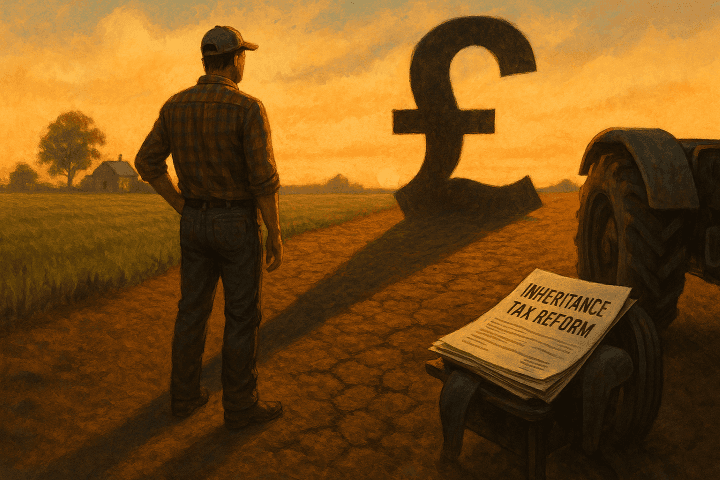
Shadow Rural Affairs Secretary Victoria Atkins tabled the urgent question following months of mounting pressure on the government over the impact of the changes, announced in the 2024 Autumn Budget, and the announcement of a further concession shortly before Christmas.
On 23 December the government announced that it would be raising the threshold at which 100% Agricultural Property Relief (APR) and Business Property Relief (BPR) applies from £1 million to £2.5 million, meaning a couple could now pass on up to £5 million of qualifying assets tax-free, on top of existing allowances such as the nil-rate band.
Explaining the change in the Commons, Dan Tomlinson, Exchequer Secretary to the Treasury, said the latest changes “go further to protect more farms and businesses while maintaining the core principle that more valuable agricultural and business assets should not receive unlimited relief.” He emphasised that, compared with the original Budget forecasts, the number of estates expected to pay more inheritance tax in 2026–27 is now forecast to halve from around 375 to 185, and that “around 85% of estates claiming agricultural property relief” would not see higher tax liabilities under the revised policy.
He also pointed to broader government support for rural sectors, including £11.8 billion investment in sustainable farming and food production over this Parliament. The minister stressed that even with the higher threshold, the reforms would still raise about £300 million by 2029–30 from the very largest estates, which will be used to support public services.
Opposition MPs argued that the threshold change, while welcome, does not go far enough and comes after unnecessary distress for farming families and small businesses.
“This partial U-turn does not save every family farm and family business,” Atkins said. “Indeed, for many the U-turn simply comes too late; we have seen record farm closures under this government, and it has taken a great personal toll on many families.”
Sir Geoffrey Clifton-Brown (Conservative) challenged the timing of the policy change, noting that farmers and rural communities had campaigned relentlessly over many months: “It took 14 months to achieve it and rural communities really do feel discriminated against,” he said.
Clifton-Brown also questioned the specifics of the change, including whether tenant farmers were fairly accounted for, reflecting wider concerns that some categories of rural landholders had been overlooked.
Lib Dem Treasury spokesperson Daisy Cooper said “this policy was a disaster from the get-go”, including a lack of consultation and warning when the original measures were introduced. She added that even the revised reliefs would still damage family farms and fail to properly target loopholes used by large private equity firms or non-farming landowners. “The changes are welcome, but they do not touch the sides,” she said, calling for the government to scrap the policy entirely and allow a free vote on amendments to the Finance Bill that would repeal it.
Another Lib Dem, Alistair Carmichael, chair of the Environment and Rural Affairs Select Committee, paid tribute “to the farming unions and others whose tireless campaigning since the Budget of 2024 has made this [change] happen.” However, he said, problems remain. It was “bizarre that in 2025, two farms could both be valued at £5 million but one of them would pass free of inheritance tax while the other had an inheritance tax bill of £500,000.” He called on the government to publish its impact assessment “so that we can all see the reasons for this change and have some confidence that they have got the figures right this time”.
However, Labour MPs backed the government’s revised approach, framing the changes as a balanced compromise between protecting family farms and closing loopholes that allowed wealthy estates to shelter significant wealth from tax.
Jim Dickson (Lab) expressed his satisfaction with the new threshold, saying he had engaged with National Farmers’ Union representatives and believed the reforms were “fairer to family farms but will still achieve their purpose of reducing tax sheltering and raising vital revenue for public services.”
Jayne Kirkham (Lab/Co-op) added that the government’s broader rural agenda — including enhancements to environmental land management schemes — demonstrated a serious commitment to food security and long-term support for rural communities.
Closing, the minister said: “We have set the threshold at £2.5 million for a single person and £5 million for a couple as a result of the changes announced at the Budget 2025. We think that threshold is right and fair. It means that the number of farming estates that will be affected will fall by half, and the vast majority will pay no additional inheritance tax at all.”
Read the full debate.
Opposition Day debate
The Conservatives returned to this issue on Wednesday 7 January, using their Opposition Day debate to once again highlight the impact they believe the changes to inheritance tax will have.
The Conservative motion criticised the impact of the government’s policies on rural communities generally, including a claim that agriculture, forestry and fishing businesses are closing at a record rate and that two pubs or restaurants are closing every day. The motion regretted what it called “the government’s chaotic approach to its plans to change Agricultural Property Relief and Business Property Relief; and [called] on the government to scrap all its planned changes to those reliefs.”
The Shadow Secretary of State for Rural Affairs, Victoria Atkins, moved the motion, saying the “family farm and family business tax fiasco” was “a textbook example of how not to govern”.
She continued: “The government’s mess of a partial U-turn will raise only enough money to pay for an afternoon in the NHS, yet… it will condemn the families operating on the slimmest of margins—who have invested in expensive machinery or who live in expensive parts of the country—to selling the family farm to pay this vindictive tax. That is why the tax must be axed.”
Rural affairs minister Angela Eagle emphasised that the government “have continued to listen and engage with the farming community and family businesses about reforms to inheritance tax” and this was why they had raised the allowance to £2.5 million.
“Let us be absolutely clear about what this Tory motion really is,” said the minister. “It is not a plan for rural Britain, and it is not a serious attempt to fix the problems that our rural communities face; it is an exercise in political distraction.”
Sarah Dyke, for the Liberal Democrats, welcomed the government’s ‘climb down’ on the ‘family farm tax’ but said the tax’s impact had already been felt. “Chris, who farms at Wheatlawn farm near Babcary, wrote to me recently. He is a fifth generation farmer with terminal prostate cancer, and he described the family farm tax as a dark “shadow” that has been hanging over him for the past year. He was terrified of leaving his son with a huge, unpayable tax bill.”
Dyke repeated her party’s call for an “emergency 5% VAT cut” for hospitality, accommodation and attraction businesses until April 2027, funded by a new windfall tax on big banks.
Labour MPs welcomed the government’s increase to the APR/BPR allowance. Michelle Welsh said farmers in her Sherwood Forest constituency had had to battle for 12 months on inheritance tax, “and I am incredibly pleased that the government have listened.”
The government used its large majority to reject the Conservative motion, voting it down by 105 votes to 332.
MPs will be debating this measure at committee stage of the Finance Bill on Monday 12 January.
Read the full debate here.