

Government accused of ‘cynical’ approach to tax changes
Many peers expressed disappointment at the Spring Statement during a debate in Grand Committee yesterday (31 March). Lib Dem Baroness Kramer accused the Chancellor of ‘cynically’ using a NICs increase now to fund an income tax cut in 2024.
Government spokesperson Baroness Penn outlined the measures in the Spring Statement, claiming the Government’s approach to developing a tax plan and its ‘ultimate goal’ of a lower-tax economy will be responsible and sustainable – but ‘cutting taxes sustainably is hard’.
Penn said reforming and simplifying the tax system has been a long-time goal of this Government. The change to NICs is the largest single personal tax cut in a decade. The tax plan also contains measures to help businesses cope with inflation and seeks to boost growth and productivity. It sets out tax-cutting options on business investment and innovation, with the final decisions to be announced in the Autumn Budget.
Conservative backbench speeches
Lord Bourne of Aberystwyth said those against the NICs increase must say where the money to pay for these extra spending elements will come from, especially with debt interest is set to hit £83 billion next year. He said the increase in the employment allowance will help employment and the extension of the annual investment allowance will boost investment. But we must be realistic that it was necessary to extend universal credit and do some things on the environment, he added.
Lord Horam said the surge in inflation has been such that we have had an incredible increase in revenue from raising the threshold. In addition, corporation tax and the rejigging of student loans have meant that the Chancellor has a ‘bonanza to play with’. Therefore, it may not have been necessary to increase national insurance or capital gains tax at all, if ‘he had only waited a bit longer’. That shows the danger of making decisions too far ahead of the real events.
Lord Balfe called for return of Schedule A which was a tax on property because a ‘huge number’ of properties stand effectively empty, as investments, disfiguring London in particular. He suggested that for the most expensive properties we should have an annual tax based on their value, saying the UK could also look at the American system of linking the tax to a rise in the value determined by house price inflation in an area.
Lord Northbrook is calling for the temporary cut to VAT for the hospitality, hotel and holiday accommodation sectors, as well as admission to certain attractions (ended on 31 March) saying its absence is a real set back for the sector.
Labour speeches
Lord Whitty is worried that there is no mention of Government’s path to ‘net zero’, such as no indication of any move towards a carbon tax, and thought the cut in fuel duty goes against climate change goals. On this theme, he complained of no action on the anomaly in the construction industry that construction and demolition do not attract VAT whereas refurbishment and retrofit do. Whitty said Sunak should have reduced the initial rate of taxation, which would primarily benefit the lowest paid, instead of fiddling with the NICs threshold. He said Rishi Sunak’s income tax cut in 2024 is a political move which discredits him.
Lord Hain said Sunak’s top priority is to make space for pre-election tax cuts by letting inflation erode the real value of October’s public spending plans. The Treasury is also stifling new policy initiatives by refusing financial backing, he said, just when renewable energy should be a top priority. Treasury traditionalists are trying to rein in the Government’s green ambitions lest they involve extra public spending, he argued.
Viscount Chandos said Sunak promising a tax cut tomorrow while allowing benefits to fall today as prices soar is just ‘not serious policy-making’. Chandos backs Labour’s call for a windfall tax on fossil fuel producers, but his refinement would be to establish not so much a one-off windfall tax but a long-term framework for the taxation of hydrocarbon production, which would recognise and therefore balance the volatility of global energy prices.
Lord Davies of Brixton railed against the increase in NICs, calling it a relatively regressive tax being used to fund a reduction in a progressive tax. The Government said that the triple lock was exceptional this year and so it would not keep their promise. How do we know that it will not decide that inflation of eight per cent or nine per cent next September is exceptional and hence provide an excuse for not fulfilling the triple lock promise next year?
Lord Sikka believes the Government’s tax policies are loaded against work and workers. He would like NICs charged on capital gains, because the recipients use the NHS and social care. He questions why workers are charged a higher rate of tax than speculators.
Labour Treasury spokesperson Lord Tunnicliffe said that while taxes are going up for working people, options such as a windfall tax were being dismissed out of ‘ideological dogma’.
Lib Dem speeches
Lord Oates said there were modest but welcome measures on the VAT cut on energy-efficiency measures but there was no reference at all in the announcement to climate change; these were seen simply as energy-efficiency measures. The Chancellor quoted a family saving £1,000 in tax on solar PV but of course they must have the money in the first place to be able to afford that, and most families do not. He added that there was nothing to close the public investment gap on improving the energy efficiency of buildings either.
Baroness Kramer said the NICs increase of 1.25 per cent funds the 1p cut in income tax in 2024; “once you allow for the threshold, the numbers trade off almost exactly. That is not just cynical; it is cruel at a moment when families need extra money just to live.” If the Chancellor had any empathy, he would have used that windfall that the oil and gas companies are receiving, she said, with that money used for a temporary VAT cut to stimulate business, a cancellation of the NICs increase and the restoration of the £20 uplift to universal credit.
Crossbench and other speakers
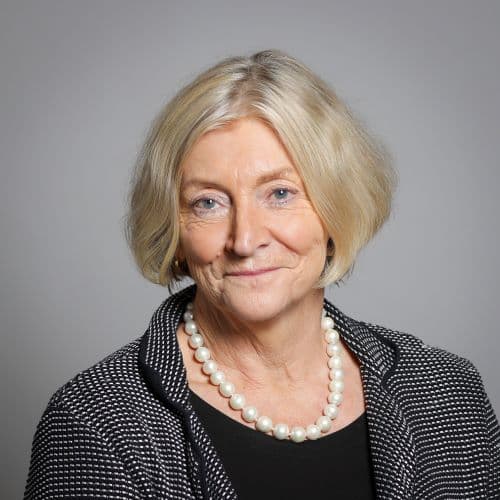
Baroness Boycott (photographed below thanks to Parliament UK) is concerned about healthy eating, urging the Government to protect incomes for those from the lowest socioeconomic groups by increasing benefits levels and protecting wages. The Government could provide nutritional safety nets and invest in the expansion of free school meals. Boycott complains that another spending Statement has passed with no mention of a needed replacement for green homes grant.
Lord Bird said we should double the education bill because it is a universal panacea out of poverty.
Lord Macpherson of Earl’s Court supports the Spring Statement and said the Bank of England has left monetary policy too loose for too long and we are now paying the price with inflation. He said that if ever there was a time to provide further help for those in and out of work, living on the basic minimum provided by universal credit, it is now. He is glad the Government is reviewing the R&D tax credit, which he fears is exploited increasingly by firms that are really not in the innovation business at all.
Lord Turnbull said we have a system for taxing housing wealth, but it is seriously flawed. Turnbull suggests reducing stamp duty and increasing council tax, so that all householders pay a moderate amount extra every year instead of the small number who move paying an enormous amount in that year. The added bonus is that these revenues could accrue to local authorities, which need more money to fund social care. All this needs a revaluation and a wholesale reconstruction of the council tax bands, which are stuck at 1992 levels, but ‘that requires political courage, which is not much in evidence’.
Lord Desai, a non-affiliated peer, said that when you tax current income from work, either through NICs or income tax, people feel the pain but, if you tax them indirectly or through unrealised capital gains, they will not feel that pain.
The Lord Bishop of Worcester said the ‘sad truth’ is that the problems facing low-income people have ‘remained great’ since 2010 and his fear is that that we are reaching ‘saturation point’ on what remedial measures civil society can realistically take. It is far from clear that Sunak’s measures will compensate for price inflation.
Government response
Baroness Penn closed the debate by saying the Government is committed to achieving ‘net zero’. Penn said the Government already place additional taxes on the extraction of oil and gas. The Government are providing support worth over £22 billion in 2022-23 to help families with the cost-of-living pressures. The best support for people to cope with the rising cost of living by helping them into work, she said.
She said the Chancellor would guarantee the triple lock for pensioners this year. The Treasury is ‘very aware of the concerns about how we are treating earned versus unearned growth’, she added, saying that dividend tax rates will rise as planned this April and not reduce in 2024.
The session is here.
By Hamant Verma, CIOT Senior External Relations Officer